MUNICIPAL GOVERNMENT INTEGRITY PROGRAM
Municipal Government Integrity Program
The Kelowna Citizens Safety Association (KCSA) has launched the Municipal Government Integrity Program to promote transparency, accountability, and ethical decision making within municipal governments across British Columbia. The program is grounded in the belief that strong communities are built through trust, and that trust depends on open governance, procedural fairness, and meaningful public participation in local decision making.
The Municipal Government Integrity Program examines how Councils exercise their authority, how residents are permitted to engage with elected officials, and whether municipal processes genuinely reflect democratic principles. Integrity in local government is demonstrated not only through policy outcomes, but through fair procedures, openness to public input, and a willingness to address issues that materially affect community well being, even when those issues intersect with provincial or federal policies.
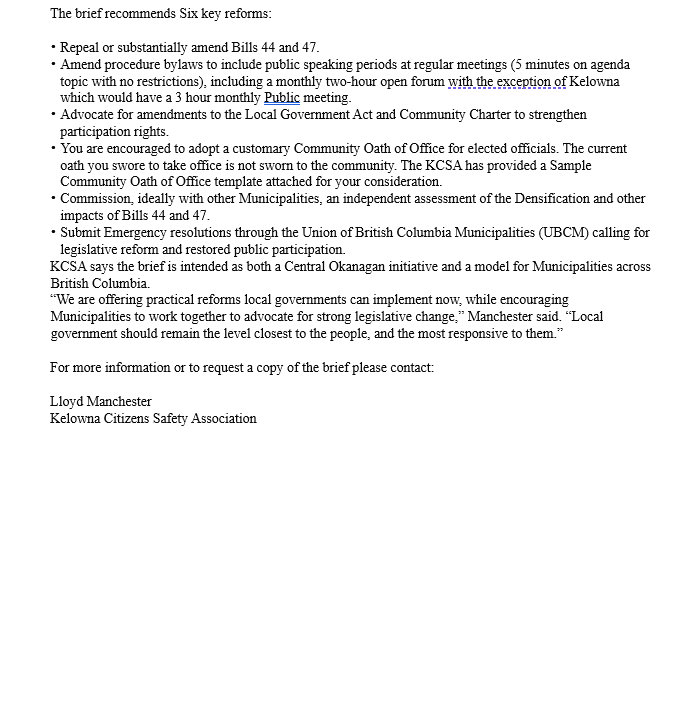
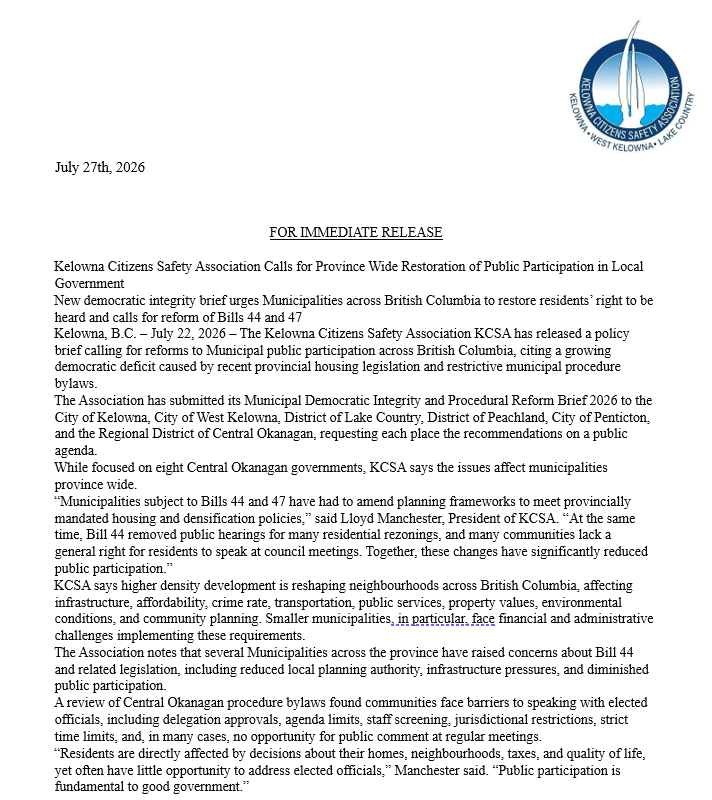
As part of the initial launch of this program, KCSA is focusing on the cumulative impact of recent legislative and procedural changes that have reduced public participation in municipal decision-making. KCSA has written to the City Councils of West Kelowna, Kelowna, and Lake Country regarding amendments to Official Community Plans (OCP's) that restrict the public’s ability to speak to Council on development matters. By broadly aligning OCP's with provincial housing targets, municipalities are now able to approve significant rezonings and densification without public hearings, preventing residents from meaningfully influencing decisions that are reshaping their neighbourhoods.
The elimination of single family neighbourhoods in favour of widespread multi family development is accelerating densification and altering the character of established communities. These changes raise legitimate concerns related to safety, psychological well being, livability, and the long term social and physical fabric of neighbourhood's. They also place increasing pressure on heritage resources and historically significant areas, where rapid redevelopment can undermine the intent of heritage conservation frameworks and the preservation of community identity.
Beyond land use, KCSA has raised concerns about the narrowing of what Councils are willing to hear from residents. Increasingly, residents are told that matters are “outside municipal jurisdiction” and therefore cannot be addressed by Council. This includes issues such as aerial spraying, the municipal impacts of provincial legislation such as DRIPA, and other policies that, while originating at senior levels of government, have direct local implications for land use, public health, environmental protection, and community safety.
KCSA has also identified procedural barriers that further limit public participation, including the absence of a guaranteed public comment period at regular Council meetings and strict time limits, often five minutes, regardless of the complexity or urgency of the issue. When combined with reduced public hearings and restrictive delegation rules, these practices significantly curtail meaningful public dialogue and weaken public confidence in municipal governance.
For these reasons, KCSA has formally asked municipalities, including the Lake Country Branch of KCSA, to review and update their Council Procedure Bylaws to improve access, transparency, and procedural fairness. The specific requests made to Council include:
Introducing a public comment period at all regular Council meetings, allowing residents to speak for a minimum of five minutes on any matter affecting the community.